- sales@zepel.co

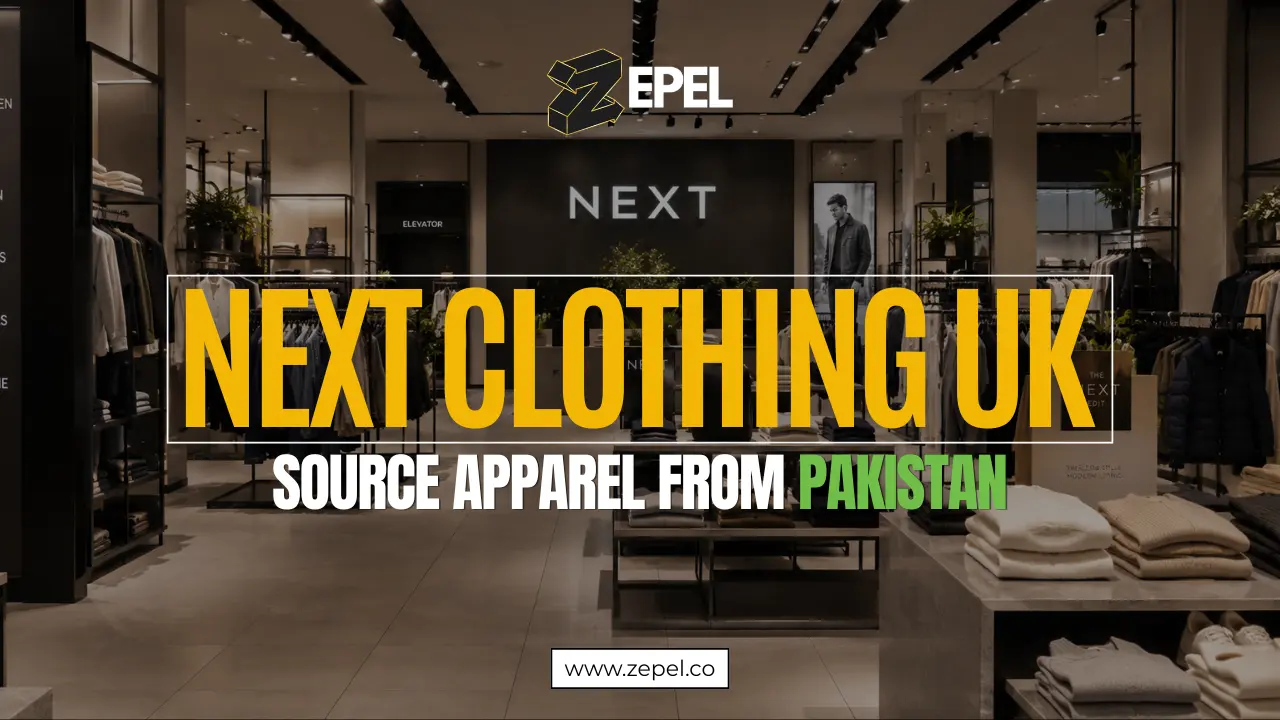
Next clothing UK is one of Britain’s largest and most recognisable fashion retailers, operating over 450 stores across the UK and generating billions in annual revenue. Behind that scale sits a global sourcing operation spanning more than 39 countries — and yes, Pakistan is one of them. For brands, sourcing managers, and fashion buyers trying to understand where Next clothes are actually made, and what the ethics behind that sourcing look like, this blog breaks it all down clearly.
Next clothing UK relies on manufacturers in China, Bangladesh, India, Turkey, Sri Lanka, Pakistan, Cambodia, Myanmar, Great Britain, Vietnam, Portugal, Albania, Brazil, Bulgaria, Italy, Indonesia, Laos, Lithuania, Madagascar, Mauritius, Moldova, Morocco, Poland, Romania, Serbia, Spain, Thailand, Tunisia, and the United Arab Emirates.
Next does not explicitly list the manufacturing locations on its product descriptions, which is common among fast fashion retailers. However, insights from their corporate website reveal that Next sourced products from 41 countries during 2021/22, with a significant portion produced in Bangladesh and China.
Bangladesh and China consistently rank as Next’s two largest sourcing countries by volume. Pakistan sits within the broader supplier base but is not individually broken out in Next’s public reporting — a common practice across UK high street retailers.
Yes — Pakistan appears in Next’s confirmed list of manufacturing countries. Beyond that, Next has taken a notable step by signing the Pakistan Accord. Company signatories to the Pakistan Accord commit to disclosing all factories producing for them in countries with International Accord programmes, ensuring all listed factories participate in inspection, remediation, and safety training programmes, and supporting factories to ensure remediation is financially feasible.
This is meaningful. The Pakistan Accord is a legally binding agreement — not a voluntary pledge — which means Next has accepted accountability for factory safety standards across its Pakistani supply base. That level of commitment goes beyond what many brands making clothes in Pakistan have signed up to.
The presence of Next as a Pakistan Accord signatory also confirms something important about Pakistan’s position in the global supply chain: it is not a secondary or marginal sourcing destination for major UK retailers. It is a primary manufacturing hub significant enough to require binding safety agreements.
Read More: Manufacturing Strategies of Leading UK Fashion Brands
Next does not publish a full, searchable public supplier list in the way some brands do. Trading ethically and doing business responsibly is a fundamental cornerstone of their business — they want their products to be made by workers who are treated fairly and whose safety, human rights and wellbeing are respected.
Next’s Responsible Sourcing Approach sets out their ambition to source 100% of key raw materials through known, responsible or certified routes between 2025 and 2030, depending on the material. Their responsible sourcing programme also covers raw materials specifically:
For brands wanting to understand which specific factories supply Next in Pakistan, that level of granular supplier disclosure is not publicly available. However, Next’s audit programme and Accord commitments mean its Pakistani supply chain is among the more monitored in the UK retail sector.
Zepel helps you connect with reliable manufacturing partners in Pakistan. Explore services
The honest answer is: it depends on how you define ethical — and Next sits in the middle of the spectrum compared to UK retail peers.
On the positive side, Next advanced its climate strategy with a 47% reduction in Scope 1 and 2 emissions from a 2016/17 baseline, and achieved 96% renewable electricity use across global operations. Its supply chain audit programme is extensive, and its Pakistan Accord membership demonstrates accountability beyond what is legally required.
On the other hand, Good On You rates Next as “It’s a Start,” noting there is no evidence it ensures workers are paid living wages in its supply chain, and no evidence it supports diversity and inclusion in its supply chain.
Most pointedly, in July 2025, it was reported by Arisa — an advocacy group for South Asian garment workers — that some Pakistani garment workers making clothes for UK high-street brands were working in poor conditions, with wages significantly below living wage benchmarks, excessive and often mandatory overtime, unsafe and unhealthy workplaces, and the suppression of workers’ rights to freedom of association and collective bargaining. The brands named as using the garment workers included Next, H&M, Inditex, Levi Strauss, Mango, BooHoo, and Primark.
This does not make Next uniquely culpable — the same report implicated almost every major UK and European high street retailer. But it does highlight the gap that persists between a brand’s stated ethical commitments and what actually happens at factory level in countries like Pakistan. The solution is not to abandon Pakistan as a sourcing destination. It is to source from verified, pre-vetted manufacturers where working conditions, wages, and labour standards are independently audited and enforced.
For smaller UK and European fashion brands watching how a retailer the size of Next approaches Pakistan sourcing, the strategic signal is clear: Pakistan is a credible, mainstream manufacturing destination for UK apparel — not an outlier or a risk play.
For UK or EU brands that have already tested a product and want competitive per-unit cost with DDP delivery, Pakistan offers a stronger overall package at the 50–300 unit tier. Pakistan’s competitive advantage for B2B clothing brands is the combination of four factors that no other manufacturing country consistently delivers together: independent triple certification (ISO 9001, BSCI, SEDEX), full vertical integration, low MOQ flexibility, and DDP logistics.
What Next’s experience also demonstrates is that sourcing from Pakistan at scale requires rigorous partner selection. The audit commitments, Accord memberships, and responsible sourcing frameworks that Next has built exist because unverified supply chains carry real ethical and reputational risk. For brands starting out or scaling up, the smarter path is to begin with pre-vetted manufacturing partners — suppliers who have already been assessed for ethical compliance, quality standards, and labour conditions — rather than discovering problems after production has begun.
Next clothing UK does source apparel from Pakistan, and its Pakistan Accord commitment signals a level of supply chain accountability that goes beyond minimum compliance. But the 2025 Arisa report is a reminder that for any brand sourcing from Pakistan — whether a global retailer or a growing label — who you partner with matters more than where you source from. Pakistan’s manufacturing infrastructure, cotton heritage, GSP+ trade access, and certification ecosystem make it one of the most strategically sound sourcing destinations for UK brands. The key is choosing the right manufacturing partners from the start.
That is exactly what Zepel exists to do. As a B2B sourcing platform connecting British and European fashion brands with pre-vetted, sustainable manufacturers in Pakistan, Zepel takes the guesswork and risk out of the equation. Every factory in Zepel’s network is independently verified for ethical compliance, quality standards, and labour conditions — so your sourcing decisions are backed by evidence, not assumptions. Whether you are launching your first collection or scaling an established label, Zepel gives you the same supply chain confidence that global retailers like Next invest millions to build internally — without the complexity.
Ready to source from Pakistan the right way? Get in touch with the Zepel team today and let us match you with the right manufacturing partner for your brand.

Get in touch