- sales@zepel.co

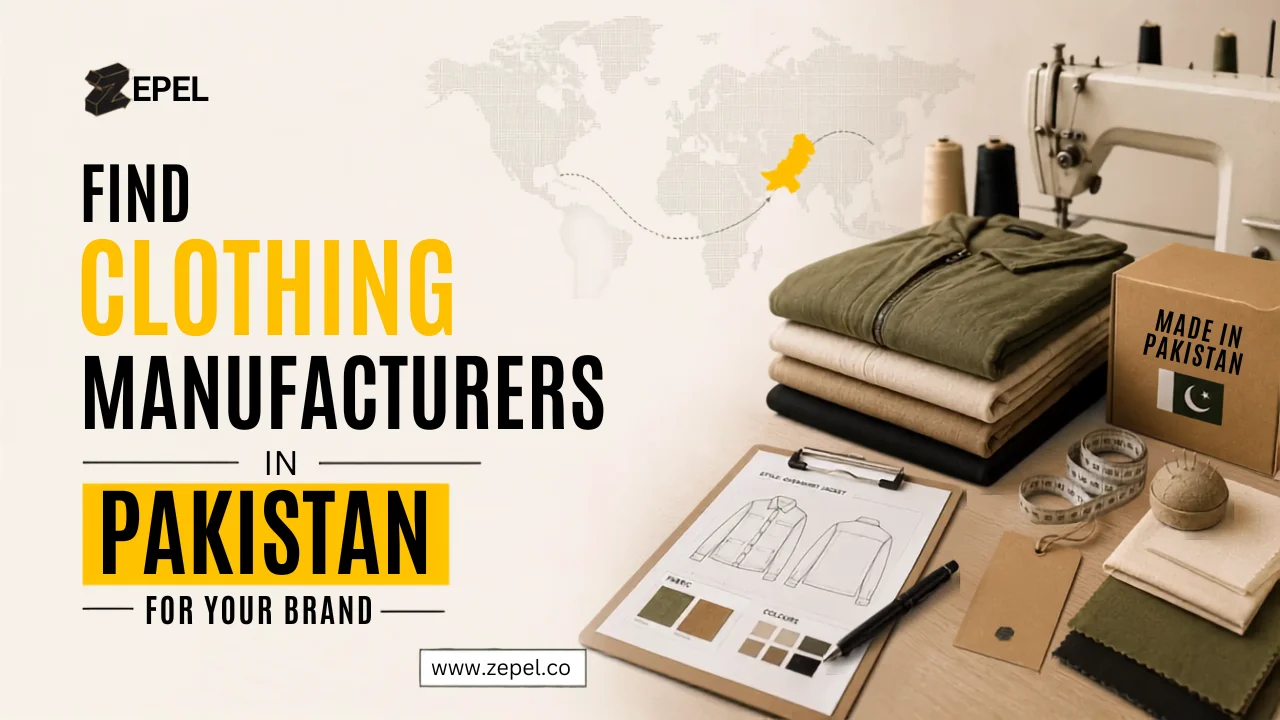
Pakistan exports more than US$17 billion worth of textiles and clothing annually, and for good reason. The country’s apparel industry has evolved far beyond raw cotton — today, Pakistan produces everything from custom gym clothing and private label sportswear to high-quality knitwear and workwear, with Sialkot emerging as a magnet for international brands seeking premium custom apparel. But with opportunity comes complexity. For fashion brands in the UK, Europe, the US, and Australia, finding reliable clothing manufacturers in Pakistan requires knowing what to look for, what to verify, and how to avoid the mistakes that cost brands time, money, and reputation.
This guide covers everything you need to know — from certifications and quality control to turnaround time and private label production.
A clothing manufacturer in Pakistan combines independently certified quality management, competitive production costs, and genuine manufacturing depth that is hard to replicate in most other garment-producing countries. For clothing brands evaluating sourcing destinations, Pakistan’s advantages stack up clearly:
Pakistan is one of the world’s top five cotton producers, giving manufacturers vertical control from raw fibre to finished garment. This means better material quality, faster fabric sourcing, and lower input costs compared to manufacturers who import their raw materials.
Pakistan holds GSP+ status with the EU and the UK, meaning apparel exported to European markets benefits from zero or significantly reduced import duties. This creates a roughly 12% landed-cost advantage over China, Vietnam, or non-GSP origins — a meaningful saving for any clothing brand scaling production.
Pakistani manufacturers have gained ground in performance wear including gym apparel, MMA gear, cycling kits, custom sports gear, and workwear — making the country a genuine option for brands across apparel categories, not just basics.
Certification is the fastest way to separate legitimate apparel manufacturers from brokers operating out of a messaging app. Look for OEKO-TEX Standard 100 (no harmful chemicals), WRAP (worker safety), BSCI (social compliance), SEDEX (ethical trading), and ISO 9001 (quality management).
Here is what each one means in practice:
Pakistan’s export-oriented garment sector has invested significantly in social compliance infrastructure since 2015, driven by buyer pressure from UK, EU, and Australian retail chains that made BSCI or SEDEX certification mandatory for supplier approval.
Beyond certifications, reliable clothing manufacturers share a set of operational characteristics that distinguish them from lower-quality alternatives.
A vertically integrated supplier controls fabric knitting, dyeing, cut-and-sew, printing, embroidery, and packaging in-house. This matters because every sub-contracted process is a point of quality risk and timeline uncertainty. Ask directly: what do you do in-house versus outsource?
For most startup and growing sportswear and apparel labels, the key criteria are low minimum order quantity, certified ethical production, performance fabric expertise, and all-in DDP delivery to the brand’s market. Quality manufacturers in Pakistan now routinely offer MOQs from 50 units per style — making custom clothing and private label accessible to brands at any stage.
Quality Pakistani clothing manufacturers work across cotton, cotton blends, jersey, French terry, fleece, performance polyester, recycled rPET, denim, modal, viscose, and ringspun and combed cotton — covering casualwear, custom gym clothing, sustainable apparel, and everything in between.
Lead time varies by factory — some deliver in weeks, while others take months depending on workload and complexity. Fast turnaround is vital for brands responding to trends or seasonal demand. Ask for detailed production schedules and past delivery performance to avoid delays.
Doorstep delivery with customs, duties, and freight handled by the manufacturer eliminates the complexity of international logistics for the brand. For clothing brands in the UK, Europe, the US, Australia, and Canada, DDP from a Pakistani manufacturer means your collection arrives at your warehouse without customs headaches.
Learn how Zepel handles end-to-end logistics
Private label clothing manufacturing in Pakistan is one of the most commercially attractive propositions for growing fashion brands. A private label manufacturer produces garments to your specifications — your design, your labels, your packaging — and ships them as your brand’s product.
Private label is the primary service of many leading Pakistani apparel manufacturers — producing under the brand’s name with custom woven labels, hangtags, polybags, and packaging, with full IP and exclusivity guaranteed.
For custom gym clothing manufacturers, custom sports gear, and custom sportswear brands specifically, Pakistan’s Sialkot cluster offers a unique combination: performance fabric expertise, low MOQs from 50 units, certified ethical production, and DDP delivery worldwide — making it the most accessible high-quality custom apparel option available to brands outside China.
Finding reliable partners starts with research and verification. Look for factories with certifications, ask for production samples, visit facilities when possible, and confirm export experience.
Practically, the verification process should include:
For brands without the time, budget, or expertise to conduct this verification independently — particularly startups or brands launching their first collection — a platform-based approach removes the risk entirely.
Zepel is a B2B sourcing platform that connects fashion brands in the UK, Europe, the US, Australia, and Canada with pre-vetted, certified clothing manufacturers in Pakistan across every apparel category — denim, knitwear, sportswear, workwear, home textile, and womenswear.
Every manufacturer in Zepel’s network has been independently verified for ethical compliance, quality certification, and production capability before being listed. Brands get the manufacturing quality and supply chain transparency that global retailers invest significantly to build — without the complexity of finding, auditing, and managing suppliers independently.
With low MOQs, inhouse logistics management, quality control at every production stage, and doorstep delivery to your market, Zepel gives growing clothing brands a reliable, ethical supply chain from day one.
Finding reliable clothing manufacturers in Pakistan is no longer the complex, high-risk process it once was — provided you know what to look for. Certifications, vertical integration, low MOQs, transparent turnaround times, and platform-based pre-vetting have transformed Pakistan into one of the most credible and accessible apparel manufacturing destinations for global fashion brands. Whether you are building a custom gym clothing line, launching a private label brand, or scaling a sustainable clothing collection, the manufacturing infrastructure exists in Pakistan to deliver it — at quality, at scale, and on time.
Start by identifying manufacturers with verified certifications including ISO 9001, BSCI, SEDEX, WRAP, and OEKO-TEX. Request samples, check export experience, verify client references, and confirm production capacity against your timeline. Platform-based sourcing through Zepel connects brands directly with pre-vetted, certified factories, removing the verification burden entirely.
The key certifications are ISO 9001 (quality management), BSCI (social compliance), SEDEX (ethical trading), WRAP (worker safety), and OEKO-TEX Standard 100 (no harmful chemicals in fabrics). Major global buyers including Decathlon, Under Armour, and Adidas require at least WRAP and OEKO-TEX from Pakistani suppliers.
Many certified clothing manufacturers in Pakistan now offer MOQs from as low as 50 units per style, making custom clothing and private label production accessible for startup and growing brands. MOQs vary by factory and product category — custom gym clothing and sportswear manufacturers typically start at 50–100 units.
Yes. Pakistan, particularly the Sialkot manufacturing cluster, is a global leader in custom gym clothing, sportswear, MMA gear, cycling kits, and performance activewear. Pakistani manufacturers work with technical performance fabrics including polyester-spandex blends, moisture-wicking fabrics, and recycled rPET, serving brands across the UK, Europe, US, and Australia.
Turnaround time varies by factory, order complexity, and volume. Standard production lead times typically range from 4 to 10 weeks from approved sample to completed bulk production. Vertically integrated factories — those handling fabric, cut-and-sew, printing, and packaging in-house — generally offer faster and more reliable turnaround times than those that sub-contract production stages.

Get in touch