- sales@zepel.co

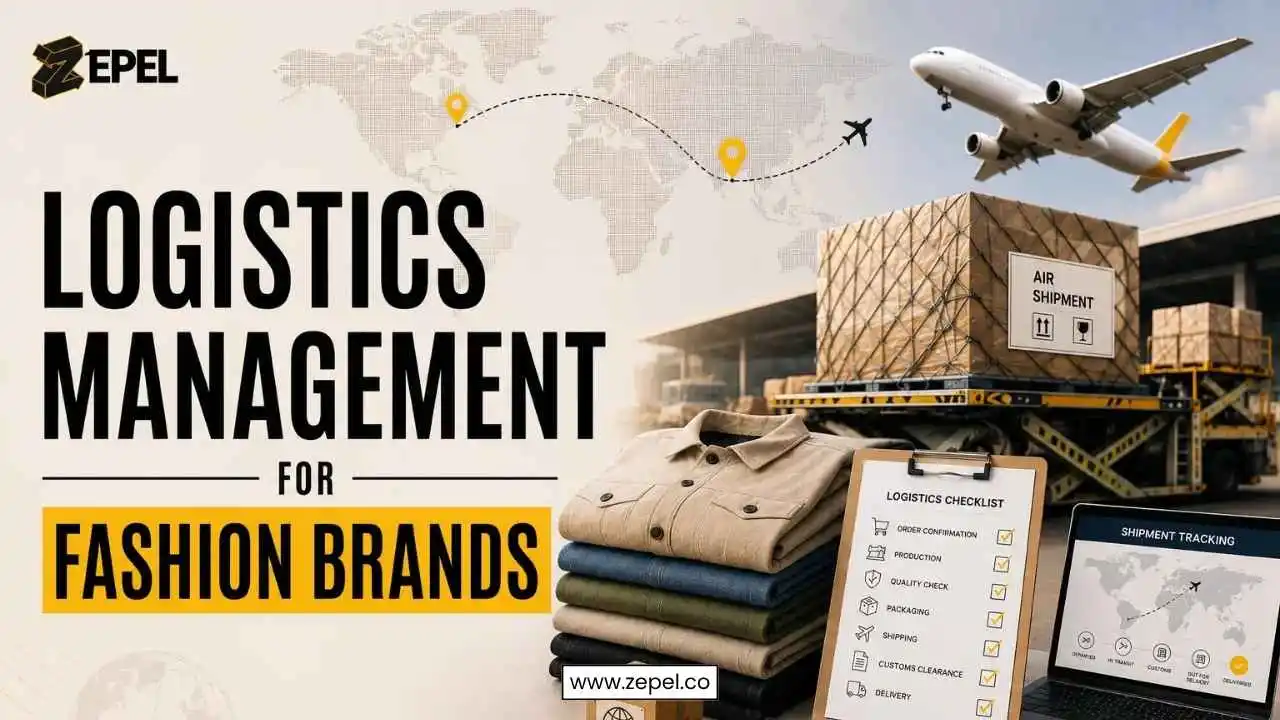
In fashion, design may capture the spotlight, but logistics determines whether collections thrive or fail. Behind every seasonal launch, online order, and international shipment lies a complex system of sourcing, shipping, and inventory management. When that system falters, even the most creative designs lose their chance to succeed. The global fashion e-commerce market is projected to reach $957 billion in 2026, and the brands thriving in that market are not necessarily those with the biggest budgets — they are the ones building smarter, more agile supply chains that can adapt as quickly as the market does. This guide covers what logistics management means for apparel brands, what to look for in a partner, and how to turn your supply chain into a genuine competitive advantage.
Logistics management is the part of supply chain management that plans, implements, and controls the efficient, effective forward and reverse flow and storage of goods between the point of origin and the point of consumption. In plain terms for a fashion brand: it is everything that happens to your product between the factory floor and your customer’s hands.
What does logistics mean in practice for an apparel brand? It covers six core areas:
For fashion brands, where trends can change in a matter of weeks, supply chain performance has become a genuine competitive advantage. Brands that can move goods faster, manage inventory more intelligently, and clear customs more smoothly than competitors land product at the right moment — when demand is highest and full-price sales are achievable.
The reverse is equally true. Online return rates for clothing average 25%, with some fashion retailers reporting rates between 30% and 40% — and stock sitting too long in warehouses results in markdowns of 25–50%, significantly reducing profitability. Poor logistics management does not just create operational headaches; it directly destroys margin.
The most successful fashion brands take a proactive approach. They partner with logistics providers that guide them through customs compliance in new source countries and offer flexibility in modes, routing, and warehousing. That flexibility — the ability to shift freight mode, consolidate shipments, or reroute around disruption — is what separates a logistics partner from a logistics vendor.
Supply chain logistics management is the integration of logistics operations into the broader supply chain — connecting sourcing, manufacturing, quality control, and distribution into a single coordinated system rather than a series of disconnected handoffs.
True end-to-end supply chain management means design, sourcing, production control, compliance, and logistics under one roof — not just freight and vendor coordination. For fashion brands sourcing internationally, this distinction is critical. A freight forwarder moves your goods. A genuine supply chain logistics partner manages the entire process — from manufacturer selection and quality assurance through customs clearance and final delivery.
51% of fashion brands are building long-term strategic partnerships with suppliers, including volume commitments, specifically because integrated supply chain partnerships consistently outperform transactional logistics arrangements on cost, reliability, and brand protection.
DDP — Delivered Duty Paid — means the logistics partner handles all shipping, customs duties, taxes, and documentation, delivering goods directly to your warehouse or fulfilment centre. For fashion brands sourcing internationally, DDP logistics removes the single biggest operational complexity from the equation: international customs. If your manufacturer or sourcing partner cannot offer DDP, you are taking on logistics risk that most growing brands are not equipped to manage.
Real-time inventory visibility across every SKU, sales channel, and warehouse location is now a baseline expectation, not a premium feature. Brands operating without it are flying blind — unable to make accurate replenishment decisions, prone to stockouts during peak demand, and exposed to the margin destruction that comes with end-of-season clearance.
Relying on just-in-time production and global distribution networks can make transportation disruptions have a big impact, causing longer wait times and higher operating expenses. A logistics partner with multi-modal capability — sea, air, and ground — gives brands the flexibility to shift between options as speed requirements and cost pressures change across seasons.
Predictive supply chain mapping technologies can streamline the customs process by making shipments more easily traceable to avoid fraud, especially as tariff enforcement increases. Beyond technology, compliance expertise matters enormously for brands sourcing from Asia, Pakistan, or other international manufacturing markets. A logistics partner who understands the tariff landscape, GSP+ trade agreements, and documentation requirements in your destination markets is a commercial asset, not just an operational one.
Generic logistics providers handle returns as a cost. Fashion logistics specialists build returns into the commercial model — with AI-driven forecasting, recommerce platforms, and sustainability compliance determining who thrives in 2025 and beyond. By 2026, EU regulations ban the destruction of unsold stock, forcing brands to develop sustainable reverse logistics models. A logistics partner without a returns strategy is a liability as regulations tighten.
For brands sourcing apparel internationally, the most efficient model is one where logistics is managed by or closely integrated with the manufacturing partner — rather than sourced separately as an afterthought.
This is where inhouse logistics capability at the manufacturing or sourcing level becomes a genuine differentiator. A manufacturing partner that handles inbound logistics, quality assurance, documentation, and DDP delivery to your market eliminates the coordination overhead that fragments most brands’ supply chains. Instead of managing a manufacturer, a freight forwarder, a customs broker, and a fulfilment provider separately, a single integrated partner handles the entire flow.
For fashion brands sourcing from Pakistan specifically, this model is particularly compelling. Pakistan’s GSP+ status with the EU and UK means apparel exports benefit from significantly reduced import duties — a meaningful cost advantage that a good logistics partner will help you maximise, not leave on the table.
Logistics management is not a back-office function for fashion brands — it is a front-line competitive weapon. The brands that source from the right partners, clear customs efficiently, manage inventory intelligently, and handle returns professionally are the ones that protect margin, hit seasonal windows, and scale without operational chaos.
Zepel provides fashion brands in the UK, Europe, the US, Australia, and Canada with end-to-end sourcing and inhouse logistics management — from pre-vetted, certified manufacturers in Pakistan through to doorstep delivery in your market. Book your free consultation at zepel.co and let us show you how integrated logistics management can become a competitive advantage for your brand.

Get in touch