- sales@zepel.co

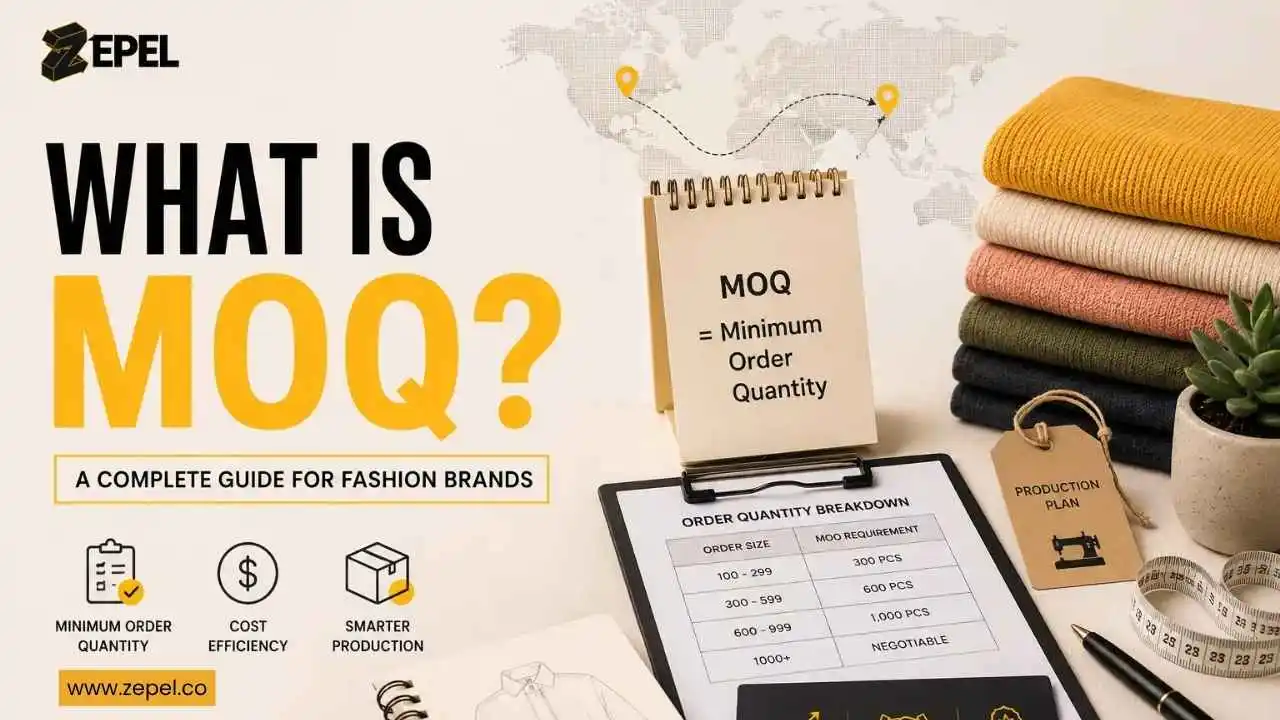
Minimum order quantity is one of the first walls every fashion brand runs into. You have a design ready, a manufacturer shortlisted, and a clear vision for your collection — then the factory quotes an MOQ of 500 units per style and the economics stop making sense. Up to 90% of fashion startups face cash flow and inventory challenges, and high MOQs are a primary contributor to the 40% failure rate seen in apparel brands during their first two years. Understanding what MOQ means, why manufacturers set it, and how to work around it is one of the most commercially important decisions a growing fashion brand makes.
MOQ (minimum order quantity) — is the smallest number of units a manufacturer agrees to produce or sell in one order. In clothing manufacturing specifically, the MOQ is usually set per style and often per colorway, so a brand cannot order fewer pieces than that figure no matter how small the budget or how simple the garment. It is the entry ticket to a production run.
MOQs exist because factories must cover the baseline costs of setting up cutting machines, sourcing fabric rolls, and programming sewing lines before a single garment is actually made. Apparel factories set MOQs to cover fixed costs such as pattern grading, marker creation, fabric spreading and cutting, sewing-line setup, machine calibration, and the overall workflow needed for a specific garment. Because these steps take nearly the same amount of time whether producing 80 units or 800, very small orders push the cost per unit too high for the factory to remain profitable.
You will also encounter two distinct types of MOQ. A factory might require a total “per order” minimum of 300 pieces to initiate production. However, they will also specify a “per style” or “per colour” minimum, such as 60 units. Understanding which type applies to your order is essential before committing to any production arrangement.
MOQs vary significantly by manufacturing destination, factory size, and product category. In the $460.6 billion global garment manufacturing market in 2026, MOQs range from 50 units in India and Portugal to 5,000+ at large Chinese and Bangladeshi operations, directly impacting per-unit costs by 20–30%.
In very general terms, fewer than 500 units is considered a low MOQ, while over 5,000 units is considered a high MOQ.
For growing fashion brands, Pakistan’s manufacturing sector sits at a genuinely accessible point in this spectrum. Cut and sew manufacturers in Pakistan routinely offer MOQs from 50–100 units per style — making custom apparel production viable for brands at launch stage without requiring five-figure capital commitments on unproven designs.
For small or emerging brands, unexpectedly high MOQs can tie up precious capital, hinder experimentation, and lead to excess inventory. Ordering 500 units of an unproven design leads to “deadstock” — unsold inventory that clogs your warehouse and drains your capital.
The inventory management problem compounds quickly. A brand launching three styles at an MOQ of 500 units each is committing to 1,500 units before a single customer has responded to the product. If one style underperforms, the capital is gone. If all three underperform, the business is in serious trouble. This is precisely why inventory control — the ability to order in smaller quantities, test demand, and replenish only what sells — is one of the most significant operational advantages a low MOQ manufacturer provides.
High MOQs also constrain sustainable supply chain management by forcing brands to overcommit to specific designs and fabrics long before market feedback is available. The brands that scale most efficiently are those that test first, validate demand, and then scale production — a model that only works when a manufacturing partner offers genuine MOQ flexibility.
There are practical ways to bring MOQ requirements down or make them more manageable without compromising quality.
Zepel’s approach to MOQ is built around one principle: growing brands should be able to access high-quality, certified ethical manufacturing without being forced to over-commit capital on unproven designs.
Every manufacturer in Zepel’s network offers low MOQs from 50 units per style across all major apparel categories — denim, knitwear, sportswear, workwear, home textile, and womenswear. This is not a compromise on quality. Zepel’s manufacturing partners hold internationally recognised certifications including BSCI, SEDEX, ISO 9001, and OEKO-TEX, and operate to the same ethical and quality standards required by major global retailers.
The low MOQ model integrates directly with Zepel’s inventory management support. Rather than locking brands into large upfront commitments, Zepel helps brands plan production in phases — launching in smaller quantities, reading market demand, and scaling into proven styles. This approach protects cash flow, reduces deadstock risk, and gives brands the operational efficiency to respond to what is actually selling rather than what they guessed would sell six months earlier.
Beyond manufacturing, Zepel manages the full production journey — from manufacturer matching and sampling through quality assurance and inhouse logistics with doorstep delivery to UK, European, US, Australian, and Canadian markets. Book your free consultation at zepel.co to find out how Zepel’s low MOQ manufacturing network can work for your brand.
MOQ is not just a manufacturing term — it is a cash flow decision, an inventory risk decision, and a brand strategy decision. Getting it right, by finding a manufacturing partner who offers genuine low MOQ flexibility without compromising quality or ethics, is one of the most impactful things a growing fashion brand can do. Zepel exists precisely to make that accessible — connecting brands at any stage of growth with pre-vetted, certified manufacturers in Pakistan who can produce from 50 units per style, with the full support of an end-to-end sourcing and logistics platform behind every order.

Get in touch